
IMPROVEMENT EXPECTED FOR 2025 BUT THE FORECASTS ARE NOT BRILLIANT.
2024 proved to be a decidedly complicated year for the Italian machine tool, robot and automation manufacturing industry, which saw a sharp decline in almost all economic indicators. Only exports recorded a small increase.
Despite this, the Italian industry in the sector confirmed itself, once again, among the main protagonists of the international scenario where it was fifth in the world production ranking and fourth in exports.
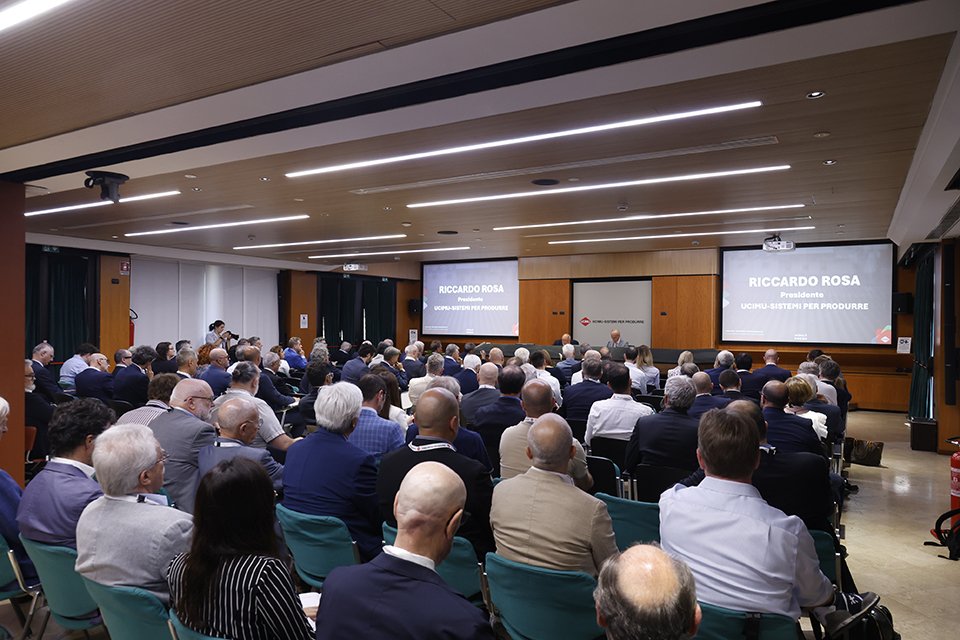
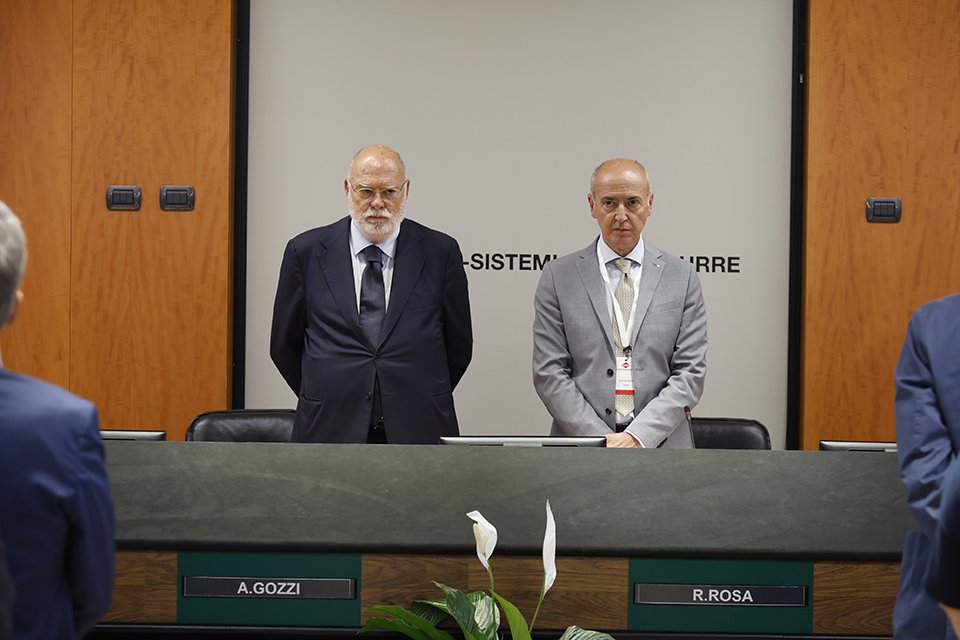
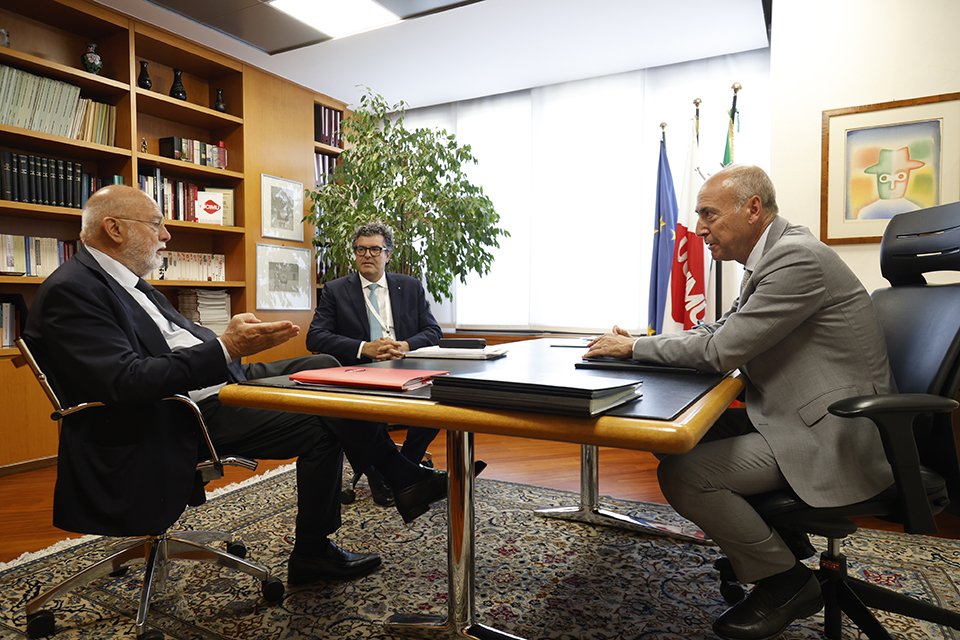
The forecasts for 2025 are of a slight improvement, compared to 2024, but the expected results are certainly not brilliant. This, in short, is the picture illustrated by the president of UCIMU-SISTEMI PER PRODURRE, Riccardo Rosa, on the occasion of the Shareholders' Meeting attended by the president of FEDERACCIAI, Antonio Gozzi.
2024 FINAL REPORTS
According to the final data processed by the UCIMU Study & Business Culture Centre, in 2024, the Italian production of machine tools, robots and automation stood at 6,327 million euros, recording a 16.9% drop compared to 2023.
The result was determined by the heavy reduction in deliveries by Italian manufacturers on the domestic market, which fell by 39.5% to 2,054 million, weighed down by the collapse of domestic consumption which stopped at 3,707 million, 36.3% less than the previous year. Imports also suffered, standing at 1,653 million, -31.8%.
The performance of Italian companies on foreign markets was different, as confirmed by the export data which grew by a timid 1.2%, to 4,273 million euros, marking a new record for the sector.
The export to production ratio rose from 55.5% in 2023 to 67.5% in 2024.
In 2024, the main outlet markets for Italian supply were: United States (629 million, +10.9%), Germany (365 million, +1.6%), China (240 million, -16.3%), France (204 million, -17.6%), Turkey (190 million, -10.3%), India (185 million, +58.3%), Mexico (176 million, -9.9%), Poland (169 million, -21.5%), Spain (157 million +21.1%), Sweden (92 million +71.4%).
The level of production capacity utilization is decreasing, with the annual average going from 86.2% in 2023 to 77.3% in 2024. The same trend also applies to the order book, which stood at 6.5 months of assured production, compared to 7.3 months in the previous year
The sector turnover stopped at 9,340 million euros.
2025 FORECASTS
As emerges from the forecasts developed by the UCIMU Study & Business Culture Centre, 2025 will mark a slight recovery in the Italian machine tool, robot and automation manufacturing industry. All indicators will return to positive territory but the increases are decidedly limited.
Production will stand at 6,490 million euros (+2.6%). Exports, expected to continue growing (+1%), will reach a new record of 4,315 million euros.
Deliveries on the domestic market will also start growing again (+5.9%), reaching 2,175 million euros, supported by the slow recovery of domestic consumption which will rise to 3,910 million euros (+5.5%). Imports will also register a positive sign, reaching 1,735 million (+4.9%).
COMMENTS AND PROPOSALS FOR INDUSTRIAL POLICY: TRANSITION 5.0, GERMANY AND STRUCTURAL MEASURES
Riccardo Rosa, president of UCIMU, at his first Assembly, stated: “After the difficult 2024, 2025 should give us some more satisfaction but never as in this case is the conditional obligatory considering the succession of truly worrying phenomena: from trade wars to military ones. All this makes our work more difficult and requires companies to make a great effort to improve their competitiveness. And to do so we must continue to invest in innovation, knowledge of the context and training”.
“Thanks to interconnection, data management, sensors, remote vision and control systems, artificial intelligence, latest-generation machine tools are real enablers of the transformation of factories in a digital and green way. We are proud - said Rosa - of how much and how our small world, made up mostly of SMEs, has contributed to the advancement of Italian manufacturing but we are aware that this development has also been possible thanks to the 4.0 and 5.0 measures that have supported and stimulated the market”.
“In a crucial moment like the one we are experiencing, with a decidedly weak domestic and foreign demand, incentive tools are essential to support the progressive and necessary change. Also because - continued the president of UCIMU - Germany, our first reference in Europe, will soon equip itself with a plan to support and relaunch its industry”.
“If the German locomotive starts up again, we - the first carriage of this train that has never stopped until now - must be ready and hooked up to it in order to continue working in the Made in German production chains which, net of the issue of duties, travels on very long routes, distributing our production everywhere in the world”.
“We ask our government for immediate intervention for the current year on Transition 5.0, to obtain the extension of its operation beyond the expected deadline. But if this is not possible, we ask at least to convert the funds still available into new measures. In this regard, we believe it is necessary to think, starting now, about the national policies that will have to accompany the development of the industry from 2026 onwards”.
“Based on experience, we believe structural measures are needed to allow companies to confidently plan their investments, thus avoiding unsustainable peaks in work for Italian manufacturers, specialized in production on order. Too often, SMEs risk losing even important orders because the lead time of a super-customized product like ours does not ensure delivery within the terms set by the incentive, also benefiting imports. A double loss in essence”.
THE ECONOMIC AND GEOPOLITICAL CONTEXT: AUTOMOTIVE/DUTY AND INSTABILITY
With respect to the context, there are two big questions that European companies must ask themselves: “what will happen or what do we want to happen to the Made in EU automotive sector and all its related industries? And how will we move with respect to the much-feared policy of duties that could trigger a domino effect on all areas of the world?”
"On the electrification of the engine - stated Riccardo Rosa - once again, we reiterate the need to enforce the principle of technological neutrality. Also because in the sustainability of this transition process, it is necessary to consider, in addition to the environmental impact, also the economic and social one. As European entrepreneurs and citizens, we know very well that the interest of young people in the car is infinitely lower than that of previous generations, but we are deciding to leave our entire market to Asia and we are risking the desertification of a fundamental part of the Eurozone economy, a premise for the impoverishment of the population. All this cannot happen".
“Community policies are needed to accompany the reconversion of plants towards different productions. Furthermore, the funds and development plans for rearmament, defense and aerospace will, yes, be able to give new impetus to the Eurozone industry but, in these sectors, you can’t improvise. Entering the galaxy of the big players in these worlds means undergoing strict assessments and certifications. And often the requirements requested represent, right from the start, a significant obstacle for many small and medium-sized enterprises”
“On duties, the United States, in 2024, was our first destination market with over 600 million machines sold. Our product – stated Riccardo Rosa – is very popular there and American factories have a terrible need for imported machinery because internal production is absolutely not sufficient to satisfy demand. For this reason we can think that the tariff barriers at entry will not be particularly penalizing for us. More problematic could be the indirect effect of the duties on the products in whose supply chains we are inserted”.
“What is decidedly penalizing is uncertainty, the real deterrent to investments in production technology, whether it is linked to the trade war so feared by President Trump or, even worse, linked to the instability of the Middle East”.
“All this - stated Riccardo Rosa - demonstrates how today geopolitics has forcefully entered our daily lives and the activities of our companies. We must all equip ourselves to learn to read the change and interpret events through comparison and dialogue with colleagues, institutions and also by relying on the representative organizations to which we belong”.
TRAINING
“We must invest in the training of our staff and young people who are the future of our companies. The latest generation machines - concluded Riccardo Rosa - need people capable of managing, programming and using them. For this reason, UCIMU has strengthened, and will do so even more in the future, its commitment to UCIMU Academy, a project that includes all the initiatives dedicated to reducing the mismatch between job supply and demand. These include the development of collaborations with high schools, universities and ITS Academy foundations linked to the world of metalworking, talent breeding grounds for our factories”.

 Industriale.it certification