
Artificial intelligence as a central theme at AMB 2026 // Guido Reimann, VDMA, discusses opportunities, challenges and current developments
At AMB, the international trade fair for metalworking, taking place in Stuttgart from September 15 to 19, 2026, Artificial Intelligence (AI) will be one of the three main topics, alongside automation and the circular economy. We discussed the progress made by the industry and the useful insights decision makers can draw from AMB 2026 with Guido Reimann. He is Deputy General Manager of VDMA Software and Digitalization and Coordinator of the VDMA Competence Network on Artificial Intelligence.
AMB: AI was a hotly debated topic at AMB 2024. Where does the metalworking industry stand today, in 2026? Has AI become a standard practice, or are pilot projects still prevalent?
Guido Reimann: For the mechanical and plant engineering sector in general, as well as for manufacturers of precision tools and machine tools, the topic of artificial intelligence has gained further importance. A VDMA survey in spring 2026 revealed that over 80% of mechanical engineering companies attach great importance to artificial intelligence technologies. Around a third of companies are already using AI solutions in production. This means the era of pilot projects is over. We are seeing increasing practical application of AI. Furthermore, many pilot projects continue to be conducted within companies to further familiarize themselves with the technology and test new application possibilities.
Current business application areas related to manufacturing focus on software development, engineering and design, business management, IT, marketing, and communications. Artificial intelligence solutions are also increasingly being used in sales and product-related services for customers in the mechanical engineering industry. To fully leverage their potential, companies must focus on their digitalization and promote it strategically.
AMB: The mechanical and plant engineering sector expects a tangible increase in efficiency thanks to AI. What specific figures and success stories do you know in the metalworking industry? And what are the main obstacles to implementation?
Guido Reimann: AI-based solutions and approaches not only promise increased efficiency, they also ensure it along the entire value chain. This is reflected, for example, in the reduction of costs for producing technical documentation and user manuals, in the time and cost savings in purchasing by increasing the number of identical components and thus improving purchasing conditions, or in the reduction of unplanned downtime, for example on machine tools, where cost savings of 10 to 20% are possible. Furthermore, AI solutions can significantly accelerate processes in many areas: development, production, sales, and customer service.
Comprehensive and sustainable digitalization is a fundamental prerequisite for the use of artificial intelligence and other digital technologies. However, obstacles often include change management, slow implementation, and a lack of human resources. Projects often fail less due to technical issues than to organizational difficulties, inadequate decision-making structures, poor engagement, insufficient knowledge of applications and limitations, and other non-technical factors. And even in the case of AI, it's true that not all pilot projects are successful. The crucial factor is knowing when to stop and redirect limited resources towards more effective digitalization activities.
AMB: Which AI technologies and application areas do you believe will dominate AMB 2026, and why is participation in AMB 2026 essential for metalworking professionals interested in AI?
Guido Reimann: In traditional product development and design, as well as in software development, we are now seeing numerous AI-based solutions offered by the software industry. At the same time, many mechanical engineering companies have integrated AI technologies into their related products or services, making them available for metalworking. At AMB, industry professionals will find not only manufacturers and suppliers of production machinery, but also software and service providers that support seamless implementation along the entire value chain.
AMB: Industrial AI, the European AI Regulation, humanoid robotics, quantum computing: the agenda is getting busier. What developments should decision makers in the metalworking industry definitely keep an eye on over the next five years?
Guido Reimann : It's true that the range of technologies, applications, and regulatory requirements relevant to the digital sector is constantly expanding. This also means that equipment manufacturers and application industries must keep pace with this change. Digital technologies are not only becoming increasingly important for internal business processes, but are also significantly influencing companies' business models. Those who are new to new digital technologies and their potential applications within their own company and in their customers' industries can lay the foundation for future success well in advance. A VDMA survey from spring 2026 also shows that mechanical engineering companies are focusing intensively on the following three technologies and intend to expand their use: artificial intelligence, digital twins, and open source software.
AMB: Thank you for the interview, Mr. Reimann.
Artificial Intelligence at the heart of the program
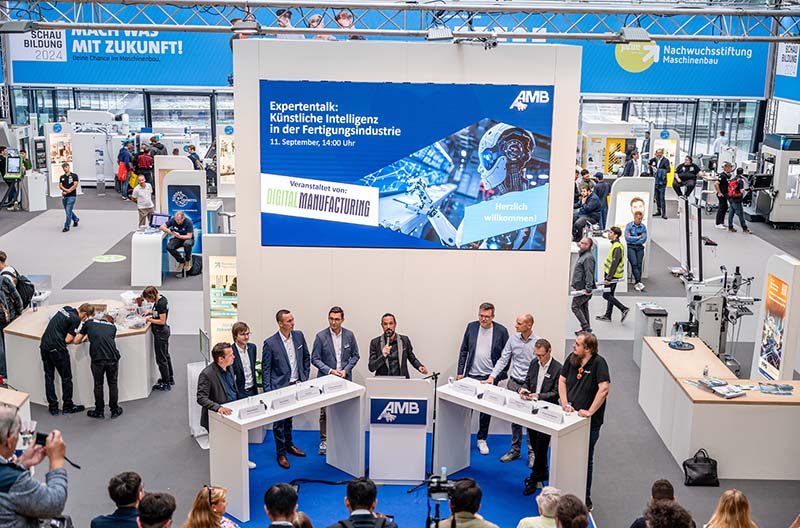
For those who want to delve deeper into the topic of AI at AMB 2026, not only by visiting the exhibition stands but also by interacting directly with experts, the AMB Stage offers two special opportunities on Wednesday, September 16: From 12:00 to 1:30 p.m., VDMA Software und Digitalisierung invites you to a panel discussion entitled "Artificial Intelligence in Production - Practical Examples." This will be followed at 2:00 p.m. by the presentation "AI in Production - From Impact to Added Value," featuring industry, research, and application professionals who will discuss current developments, concrete application examples, and open questions related to the use of AI in mechanical processing. The AMB Stage is located in the atrium (EO010) at the east entrance.
About AMB
Since 1982, AMB has presented the highlights of the international metalworking industry. "Where metal comes alive" will also be a regular event on the industry's agenda in 2026, this year from September 15 to 19. It is the international marketplace and meeting place for metal cutting, showcasing the latest products, technologies, innovations, services, and concepts in all their facets. AMB is supported by the VDMA Precision Tools, VDMA Software and Digitalization, and the VDW Verein Deutscher Werkzeugmaschinenfabriken e.V. (German Machine Tool Builders' Association). Further information is available at www.amb-messe.de/
Ucimu: orders index in the third quarter of 2026 rise (+10.5%) foreign orders (+24.7%); domestic ord
In the third quarter of 2026, the machine tool orders index compiled by the UCIMU-SISTEMI PER PRODURRE Study & Business Culture Centre recorded a 10.5% increase compared to the July-September 2025 period . In absolute value, the index stood at 58.9 (base 100 in 2021). In particular, orders collected across borders grew by +24.7% compared to the third quarter of 2025, for an absolute value of 108.6. Order intake in Italy, however, decreased by 7.1% compared to the same period of the previous year. The absolute value of the index stood at 14.3. Riccardo Rosa , President of UCIMU-SISTEMI PER PRODURRE, stated: " Domestic demand remains weak despite the numerous ongoing negotiations. The uncertainty of the international context and the increase in energy costs are clearly impacting the activity of Italian manufacturing operators, who are postponing investments pending greater clarity. We are therefore confident ," added President Riccardo Rosa , " that Italian demand will be able to regain momentum, also supported by the hyper-depreciation measure which, in version 5.0, allows for better planning of investments, which can be spread out until September 2028. " Italian manufacturers' activity on foreign markets, however, has been decidedly dynamic. In addition to the United States, where demand remains particularly strong, Germany is also beginning to show signs of recovery: certainly good news for the Italian industry in the sector. According to data processed by the UCIMU-SISTEMI PER PRODURRE Study & Business Culture Centre, in the first half of 2026 (latest available data), the main outlet markets for Italian supply in the sector were the United States (329 million euros +12.6%) and Germany (137 million euros, +7.6%), followed by France, Poland, and Spain. “In particular, the aerospace and defense sectors, as well as the energy sector, are driving orders, regardless of the country of reference,” concluded Riccardo Rosa . These are the latest sector data presented by the president of UCIMU-SISTEMI PER PRODURRE, Riccardo Rosa , on the occasion of the inauguration of 35.BI-MU, the international sector event taking place at fieramilano Rho from 12 to 16 October . Speakers at the meeting chaired by Rosa included Valentino Valentini , Deputy Minister of the Ministry of Enterprise and Made in Italy; Giovanni Bozzetti, President of Fondazione Fiera Milano; Simona Greco , Hosted Exhibitions Director of Fiera Milano; and Luca Durante , Head of the Capital Goods Office at ICE-Agenzia. The second part of the event featured an interview with Gian Piero Cutillo, Co-General Manager of Leonardo, and Roberto Vavassori , Executive Director of Brembo and President of ANFIA, conducted by Paolo Bricco, Special Correspondent, Il Sole 24 Ore. The event features over 400 companies , spread across a total area of 40,000 square meters in pavilions 22 and 24. The spotlight will be on machine tools, robotics, automation, additive manufacturing, digital manufacturing, artificial intelligence, measurement and quality control systems, components, and enabling technologies for the smart factory. The event, promoted by UCIMU-SISTEMI PER PRODURRE and organized by EFIM-ENTE FIERE ITALIANE MACCHINE, significantly enhances the thematic cultural dimension. Over 50 events are planned , including conferences, workshops, and round tables. New features this year include two special forums dedicated to the Aerospace & Defense and Energy sectors, strategic sectors that will be analyzed through the direct testimony of production and operations directors of some of the main international players and the CEOs of several Italian SMEs. In terms of training, the VLF4EU (Virtual Learning Factory for EU) International Conference is particularly relevant, focusing on an innovative training system based on the Digital Twin of the factory. The conference will feature around thirty researchers from Denmark, France, Slovenia, Spain, Sweden, and Italy. The relationship between young people and the world of work will be explored in depth at the meeting " Value, Future, Impact. Work According to the New Generation ," organized by ANIPLA with the patronage of the UCIMU Foundation. These conferences are part of the Skills Area 's calendar of meetings. Located in Pavilion 24, the Skills Area will host initiatives promoted by UCIMU Academy and the UCIMU Foundation . Among these, ROBOTGAMES , the automation and robotics competition for secondary school students, now in its second edition, will once again be held.
 Industriale.it certification