
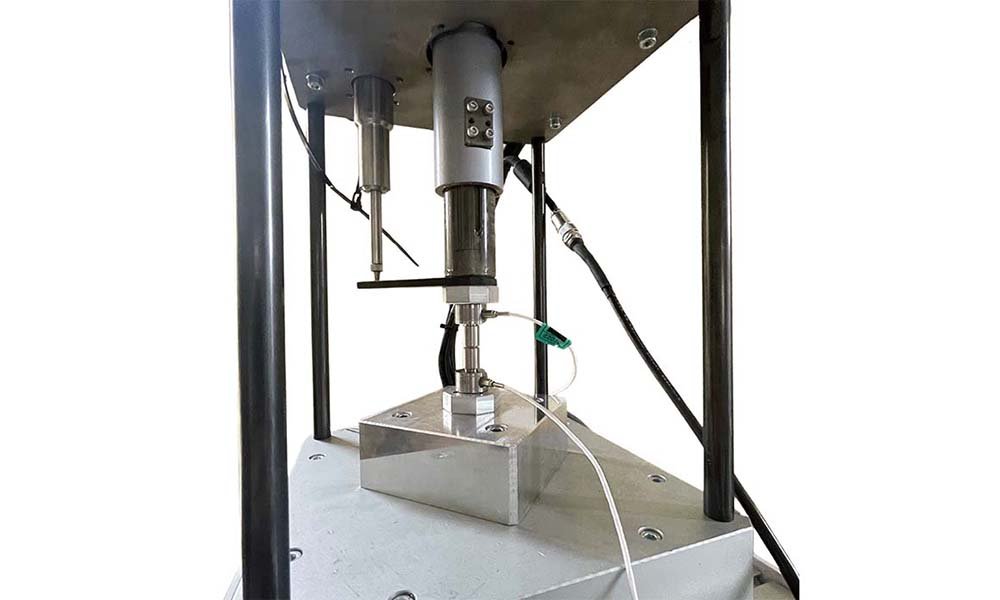
Adding a high-precision load cell to a Coretec servo press dramatically improves the performance of the CORETEC WPS “Work Explorer” feature.
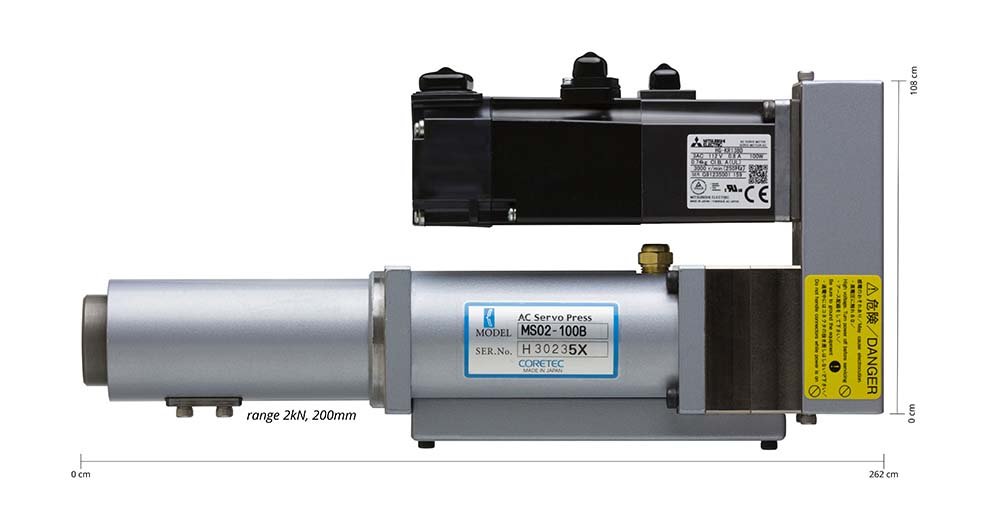
Coretec tools (for example the GS and MS servo press series) are highly sophisticated measuring instruments.
They don't just push, they analyze:
Work Explorer Function:
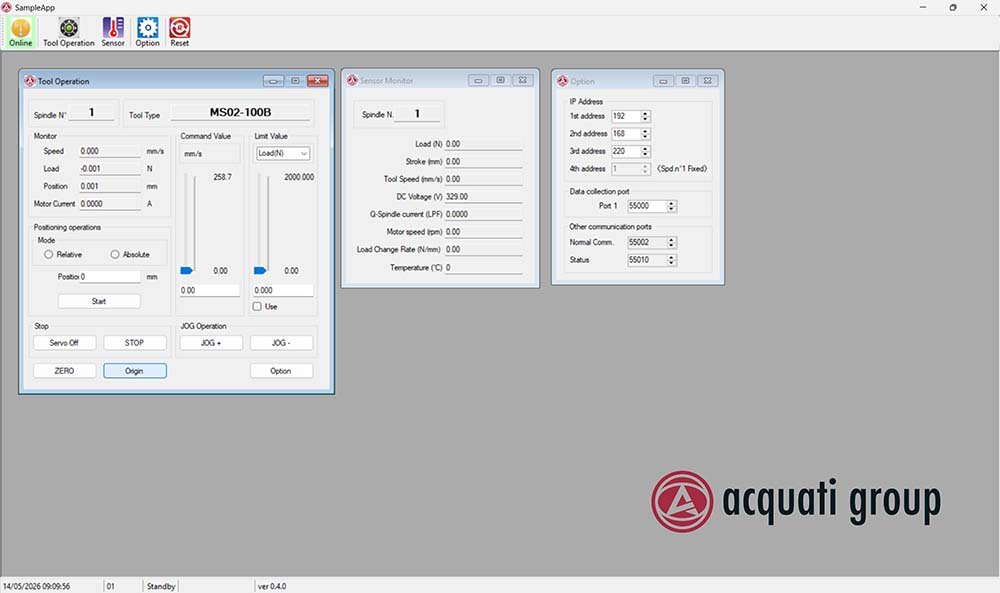
Coretec controllers feature a Work Explorer mode. This allows the punch to move at a specific search speed until it detects a minimal change in force (contact). It then records the exact position, effectively acting as a contact probe.
High sampling rate:
Coretec is known for its ultra-high-speed data processing (over 1000 samples/sec), which is essential when using the servo press as a probe to ensure the trigger point is accurately detected.
Improved features:
1. High sensitivity to contact (trigger point). The standard load cell integrated into a servo press is sized for the maximum capacity of the machine (for example, 5 kN). For this reason, it does not have the resolution necessary to detect very small contacts.
Advantage: An external sensor can be specifically sized for the probing phase (for example, to detect a 0.5 N contact on a 5 kN machine). This ensures that the servo press stops when it touches the surface without deforming the part, providing a much more precise zero-point measurement.
2. Eliminate internal friction (noise). Internal sensors must account for the friction of the ball screw, motor bearings, and seals. This mechanical noise can mask the actual force at the tool tip.
Advantage: An external sensor mounted directly on the tool measures only the force applied to the workpiece. This clean signal allows the Coretec Work Explorer function to activate with much greater repeatability, as it is unaffected by heat, wear, or the internal mechanics of the servo press.
3. Micron-level dimensional accuracy. When using a servo press as a probe, you often try to calculate a relative dimension (for example, measuring the height of a component to determine how much shim to insert).
Advantage: Since the calculation is Force + Displacement, any error in the force detection results in an error in the recorded position. A more accurate sensor reduces this uncertainty, allowing for tighter assembly tolerances that are impossible to achieve with a standard internal sensor.
4. Direct traceability. In various industries, such as medical device manufacturing and the aerospace industry, servo presses are often considered measuring instruments.
Advantage: It is significantly easier to calibrate and certify a high-precision external load cell to international standards than to calibrate the entire internal drive system of a servo press.
Coretec with external sensors:
The WPS controller is designed with high-speed analog inputs to specifically handle this external sensor, making it very easy to implement a high-precision secondary force feedback loop.
Kipp presents the new remote product line - safe locking and actuation from a distance
KIPP is expanding its range with the REMOTE product line, designed for applications where control elements are not directly accessible. The line primarily includes locking pins, actuating devices, and snap-action latches that can be connected via Bowden cables. A new online configurator, available directly on the respective product page, helps customers select the most suitable components for their application. When installation space is limited or certain functions are not, or should not be, directly accessible, the control point must be relocated. It is precisely for these situations that KIPP has developed the new REMOTE product line. The range primarily includes locking pins, actuators, and latches and is designed for applications requiring the safe remote control of mechanical functions. In machine and equipment construction, this primarily concerns the opening and closing of doors and enclosures. With swivel or rotating devices, however, the focus is on achieving defined locking positions, while in special vehicle construction, the requirement is to securely position the stops. The requirements are similar, but the installation conditions are often different. To this end, REMOTE combines coordinated components connected via Bowden cables. Force transmission is mechanical, and the control side can be freely positioned. It is also possible to centralize access to functions by connecting multiple locking devices to a single control element via Bowden cables. Conversely, a function can be operated with two independent control elements. In hard-to-reach areas and with large moving parts, this solution significantly improves handling and ergonomics. During installation, the cable control can be adjusted to the required length, allowing different installation conditions to be accommodated without the need for additional special solutions. New locking pin platform with online configuratorThe heart of the REMOTE series is a new locking pin platform for remote actuation. This is complemented by specially designed and design-matched control elements. This new range was developed in response to numerous customer requests for customized solutions, which have now been incorporated into a broader standard range. New additions include variants with extended locking pins, as well as versions with hexagon and thread, with through-threaded sleeve, or with smooth sleeve. The range has also been expanded on the control side. In addition to various handle variants, such as T-grips, star grips, or clamping levers, solutions with one or two Bowden cable connections are available.To enable you to quickly and confidently choose the most suitable solution from the numerous variants, KIPP has developed an online configurator. Available directly on the respective product page, the configurator guides the user through the relevant parameters and combines compatible actuators, locking pins, and cable distributors. This provides designers with a reliable basis for selection, without having to individually test each combination. The configured solution can be transferred directly to the ordering process.Pneumatic locking pins for automated processesIn addition to mechanical solutions, the KIPP range includes pneumatic locking pins with end-of-travel detection. They are used in applications where manual actuation is not possible, such as in automated processes or where cycle times are short. The pin can be operated entirely by compressed air. At the same time, an integrated sensor signals whether it is in the extended or retracted position. This provides the system control system with clear status information.Brief profile of HEINRICH KIPP WERKHEINRICH KIPP WERK is a specialized manufacturer of clamping technology, standard parts, and control components. Its products are manufactured in Germany using a large fleet of machinery. The range includes over 90,000 items, which are quickly available thanks to the company's logistics center. KIPP is therefore a reliable partner for industry and the plant and mechanical engineering sectors.KIPP develops all its products in-house and tests them in a quality assurance process. Thanks to a high degree of production integration, the company is able to produce standard elements, assemblies, and special solutions. When developing KIPP control components, special attention is paid to ergonomics and robustness.HEINRICH KIPP WERK was founded in 1919 and since 1950 has focused on the development of in-house designed clamping devices, such as the classic KIPP clamping lever. The company employs over 530 people worldwide and is present in more than 50 countries.

 Industriale.it certification